
How to choose the right translation company — and not fall for the tier trap
Most churches shopping for live translation for church services get lost in feature lists. The faster way to the truth is the pricing page — not the number at the top, but the shape of it. The shape tells you whether you’re buying the product you saw in the demo, or the entry ticket to it. This guide covers the two traps to watch for, what actually drives a provider’s cost, and the four questions that sort the market in an afternoon.
Trap one: the tier trap
You watch the demo. You love it — the notes page, the response cards, the voice. You check the price, see the entry plan, and budget for it. Then, sometime between the contract and the third Sunday, you learn that the features you fell for live two tiers up.
That’s the tier trap: the demo sells the top tier, the quote cites the bottom one. Nothing dishonest was said — the trap is in what was priced. The tell is easy to spot once you look for it: a features page where the rows you care about carry tier names, or a pricing page where “everything in the previous plan, plus…” carries the actual product in the “plus.”
The question that springs it: “Which of the features on your website are NOT included in the plan you just quoted me?” Ask it in writing. An honest provider has a short answer.
Trap two: the listener-limit trap
The second trap prices your congregation by the head — per-listener fees, or plan limits that force an upgrade the moment your ministry grows.
Here’s the economics worth understanding before you sign anything. In live AI translation, the expensive work is producing each language — turning the sermon into Spanish, into Korean, into Portuguese, live, hour after hour. Once a language is being produced, delivering it to one phone or a hundred phones is essentially the same broadcast. A hundred guests reading Spanish cost a provider roughly what one guest reading Spanish costs. A second language is genuinely more work; a second listener is not.
This isn’t hypothetical — headcount-scaled pricing is common in this market. OneAccord’s pricing section, for example, says in its own words that “pricing is based on languages, hours, and number of users” (as published in July 2026). Languages and hours are the real cost drivers; the third lever is the one to question. And the quiet version of the same trap is a low listener cap on the entry plan that isn’t published at all — you discover it in the quote, after the demo. Always ask for the number of listeners your plan includes, in writing, before you compare prices.
So when a price scales by headcount, ask what you’re actually paying for. Growth in listeners is your ministry succeeding — a pricing model that charges you for it is charging you for your own harvest. Hours, languages, and honest capacity planning drive real cost; per-listener fees mostly drive invoices.
Trap three: the hours trap
The third trap is the small number quietly doing the selling: an entry plan with 4 or 5 hours a month. Do the Sunday math before you sign. One service a week is four services most months, five in the long ones — and services run long: worship goes an extra song, the message lands, the altar call isn’t going to be cut off for a meter. A single weekly service realistically needs about six hours a month. An entry plan below that isn’t priced for your church; it’s priced to get you in the door, because the plan’s real price is the plan plus the overage you’re guaranteed to hit.
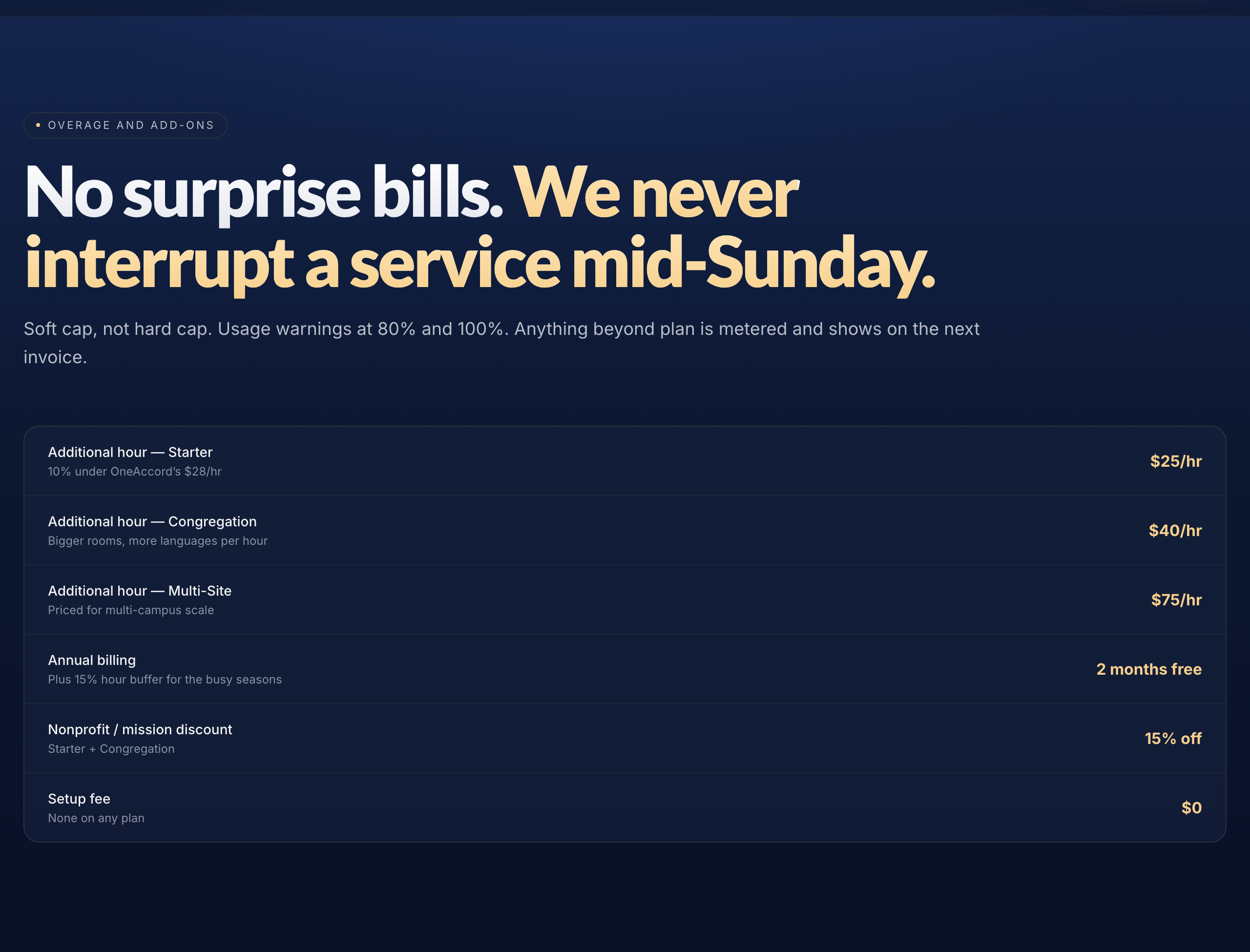
So read the overage terms before the plan price. The questions that expose this trap: What does one extra hour cost? Can I buy exactly one, or only a bundle? And is the rate published? Overage sold only in bulk, or priced only in the quote, is the tell. For reference, our overage is published per plan and sold by the single hour — $25 on the entry plan, no bulk blocks — with usage warnings at 80% and 100% of your plan so the invoice is never a surprise, and a 15% hour buffer added on annual plans (which takes the entry plan to 6 hours — the Sunday math, covered).
How we price it — and why
Since this is our guide, here’s our own pricing held to the same lamp, so you can judge us by the standard we just handed you:
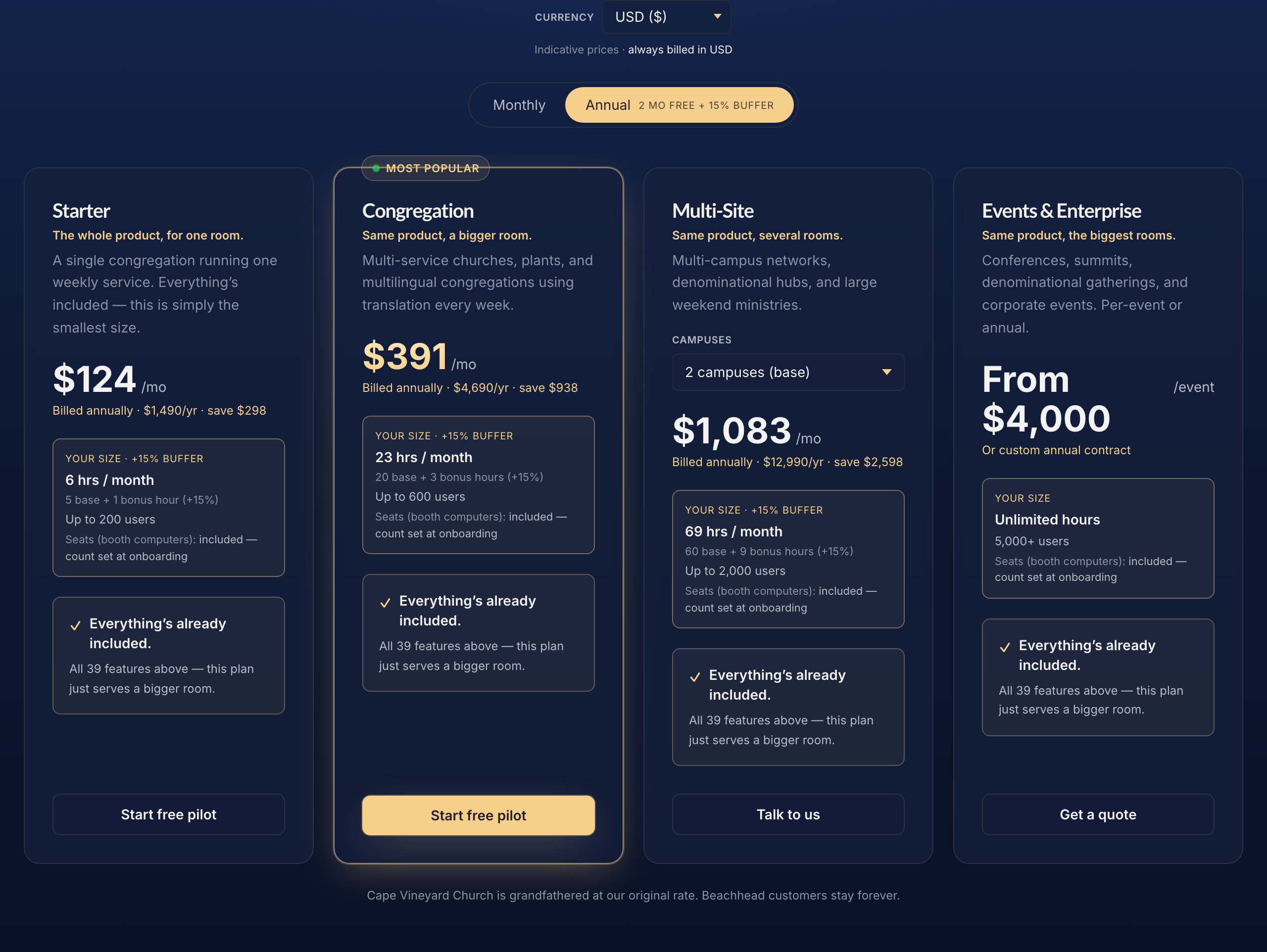
- Every feature on every plan. The $149/month Starter runs the same tool as our largest plan — the notes, the cards, the announcements, the voice, all of it. We don’t hold features back to sell them twice, for one reason: the guest sitting in a church of sixty deserves the same experience as the guest in a church of six thousand.
- We charge for what honestly costs more. Our plans scale by service hours and room capacity — the things that genuinely cost more to provide. A fair price has to cover our costs, and yes, we have to make money. But it doesn’t have to gate the experience.
- No per-listener fees. Each plan includes generous room capacity (200 listeners on Starter, up to 2,000 and beyond for events); within it, your growth is free. Ten more guests scanning the QR code this Sunday costs you nothing.
- All of it published. Every tier, every cap, $0 setup, a 15% nonprofit discount on Starter and Congregation — on one page, so you can do this math without talking to anyone, including us.
The four questions that sort the market
- “Is your full pricing published?” Quote-only pricing isn’t automatically dishonest, but it moves the comparison onto the provider’s turf. Published pricing lets you compare at your kitchen table.
- “Which features on your website are not in the plan you quoted me?” The tier-trap detector. Get it in writing.
- “What does one more listener cost me? And one more language?” The honest answers are “nothing, within your plan’s capacity” and “here’s the real number.” If the listener answer has a dollar sign, you’ve found the trap.
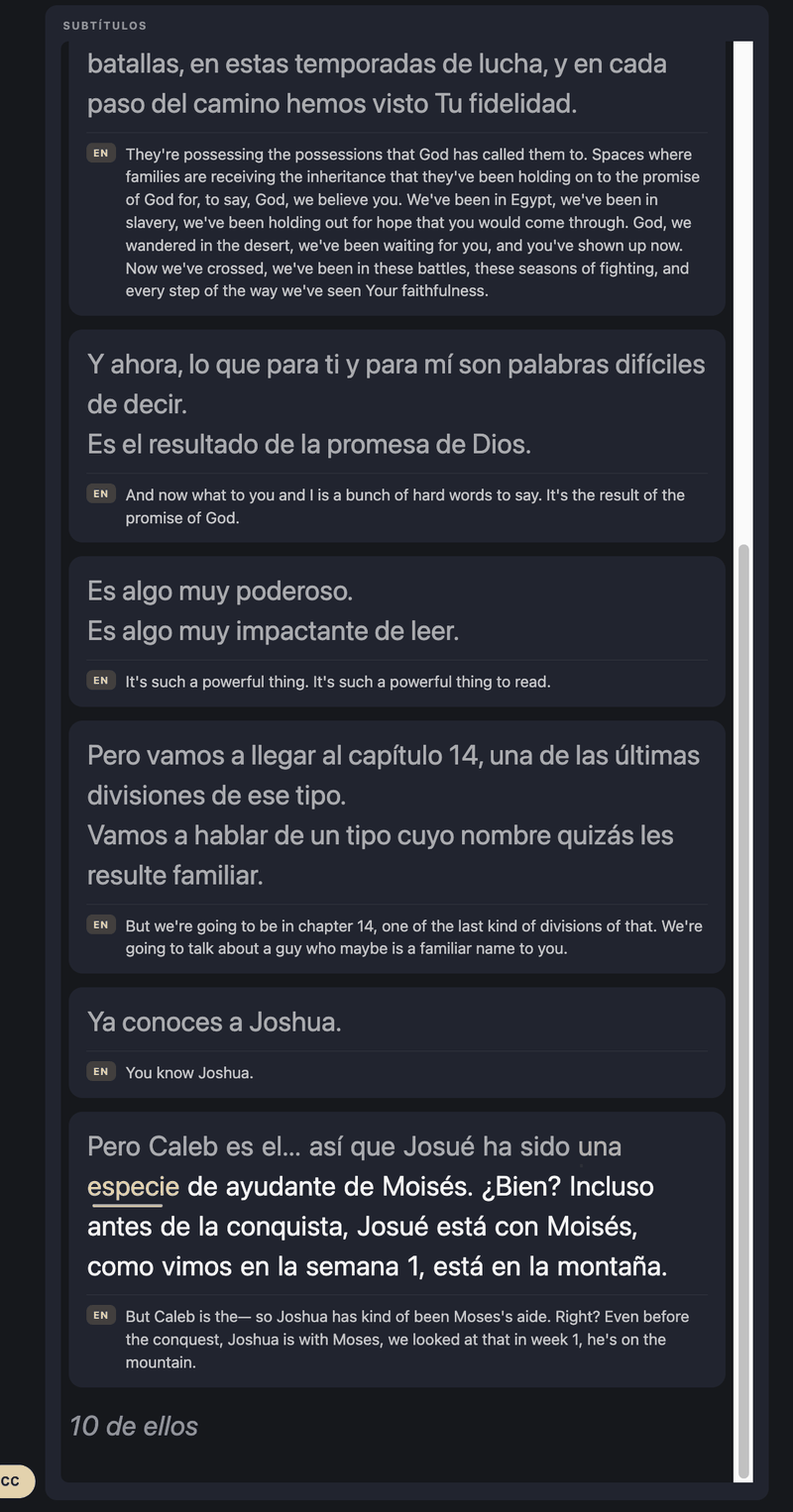
- “Can I run a real service before I commit?” A demo in a quiet office proves the demo. A real Sunday with your real congregation proves the product. Ours is free for a weekend, no card — whatever you evaluate, insist on the equivalent.
The bottom line
Choose the company whose pricing page you could explain to your finance team in one breath: what it costs, what it includes — everything — and what changes as you grow: nothing, until your hours or your room genuinely do. For a side-by-side of the six services churches most often compare, published number by published number, see the full comparison.
Frequently asked questions
What is the “tier trap” in translation pricing?
It’s when the features that made you want a service — the ones in the demo — turn out to live on a higher tier than the price you were quoted. You budget for the entry plan, then discover the entry plan isn’t the product you saw. The tell: a features page where the best rows carry a tier name next to them.
Should a church pay per listener for live translation?
Ask what an extra listener actually costs the provider. Once a service is being translated into a language, delivering it to one phone or a hundred phones in that language is essentially the same broadcast. Per-listener pricing charges you for your growth, not for the provider’s work. Languages are different — each one is genuinely more work — so languages, hours, and capacity are honest things to price; headcount largely isn’t.
What actually drives the cost of live translation?
Time and languages: how many hours of service are being translated, and how many languages are being produced at once. That’s why honest plans scale by hours and capacity. A hundred people reading Spanish cost roughly what one person reading Spanish costs; a second language is real additional work.
How does MyOpenDoor Translate price it?
Every feature on every plan — the $149/month Starter has the same tool as the largest plan, because a guest at a church of 60 deserves the same experience as a guest at a church of 6,000. Plans scale by what honestly costs more: service hours, room capacity, and how many languages you carry — 3 on Starter, 5 on Congregation, 7 on Multi-Site, all published on the pricing page rather than discovered later. Full pricing is published — $0 setup, a 15% nonprofit discount on Starter and Congregation, no per-listener fees.
What questions reveal an honest translation price?
Four: Is full pricing published, or quote-only? Which features on your site are NOT on the entry plan? What does one more listener cost me — and one more language? And can I run a real service free before committing? Any provider comfortable with those four is safe to shortlist.
Related reading: how much church translation costs, the full service comparison, and the best church translation apps in 2026.