
Church translation equipment: what you actually need
If you’re pricing translation equipment for your church, you’re probably picturing a cabinet of receivers, a charging station, and a box of headsets to sanitize every week. That was the equipment list for decades. In 2026 there are two honest answers — the traditional hardware stack, and a list short enough to fit in one sentence: an audio feed, a laptop, an internet connection, and the phones your guests already carry. This guide lays out both, including the one case where the old hardware still wins.
The traditional setup: receivers and headsets
Dedicated interpretation hardware — RF or FM transmitters at the booth, a receiver pack and headset per listener — has served churches well for a long time, and it still works. Here’s what running it actually involves week to week:
- Per-listener hardware. Every guest who wants translation needs a receiver in their hand — which means buying enough units for your largest crowd, not your average one, and buying more as you grow.
- The handout ritual. Someone charges the receivers, hands them out, explains the volume wheel, collects them after the benediction, cleans the headsets, and chases the ones that walked out in a coat pocket.
- A human interpreter per language. The hardware only carries a voice — someone still has to produce the translation, live, every service, for every language you offer.
- Its genuine advantage: no internet required. RF doesn’t care whether your building has Wi-Fi or cell coverage. If your sanctuary is a concrete basement with neither, this is the row that decides it — and the rest of this guide matters less for you.
The modern list: four things, three of which you have
A phone-based system like MyOpenDoor Translate replaces the receiver cabinet with the phones already in the room. Here is the complete equipment list:
- 1. An audio feed. A line out from your soundboard is best; a USB mic or a wireless lavalier into a phone also works. If your church runs sound at all, you already have this.
- 2. One laptop or phone in the booth. It runs the broadcast console in a normal browser. Whoever runs your slides can run this — here’s the walkthrough, and here’s what translation looks like from the sound booth.
- 3. An internet connection for the booth. Wired beats wireless: if your Wi-Fi is shaky, wire the booth. Guests use their own data or your guest Wi-Fi, kept separate from the booth connection so a crowded guest network doesn’t take the broadcast down.
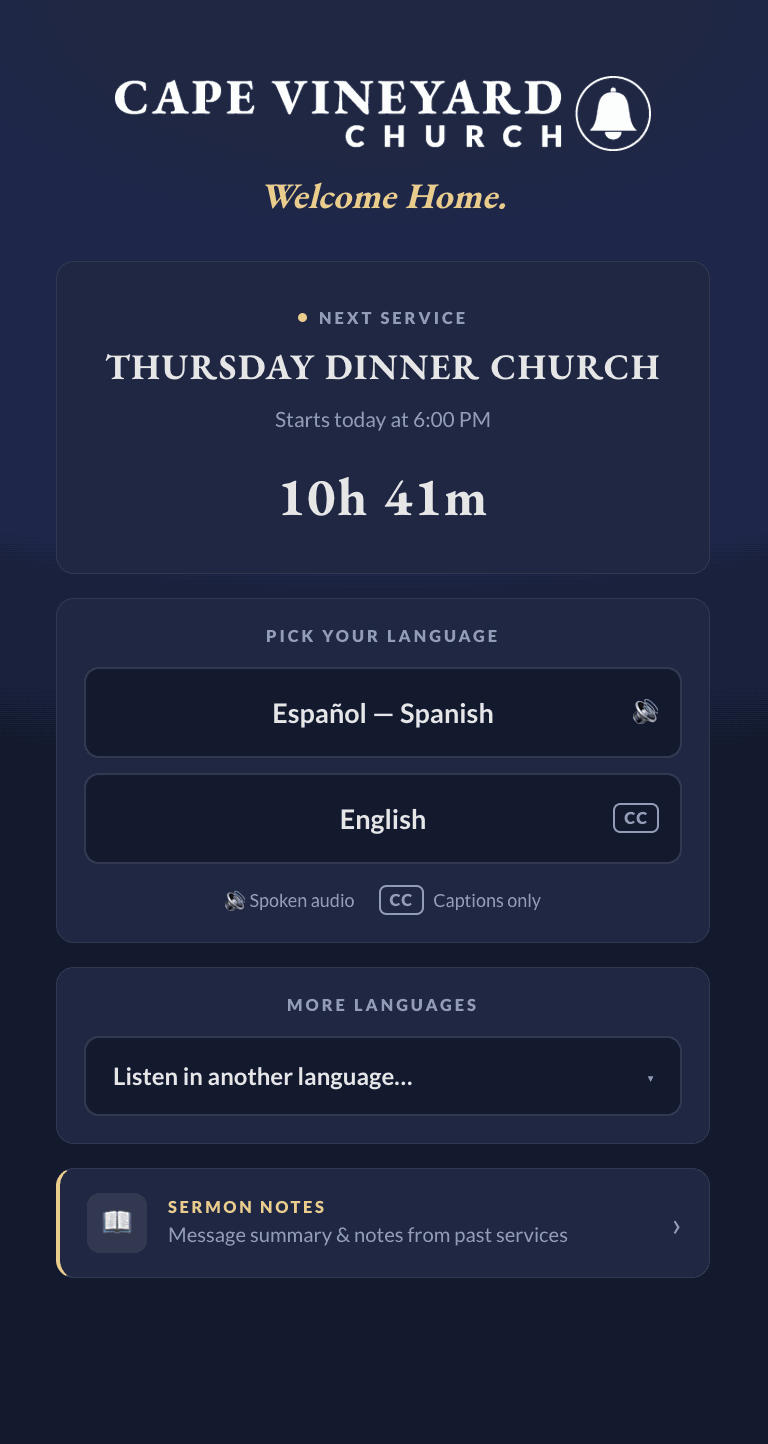
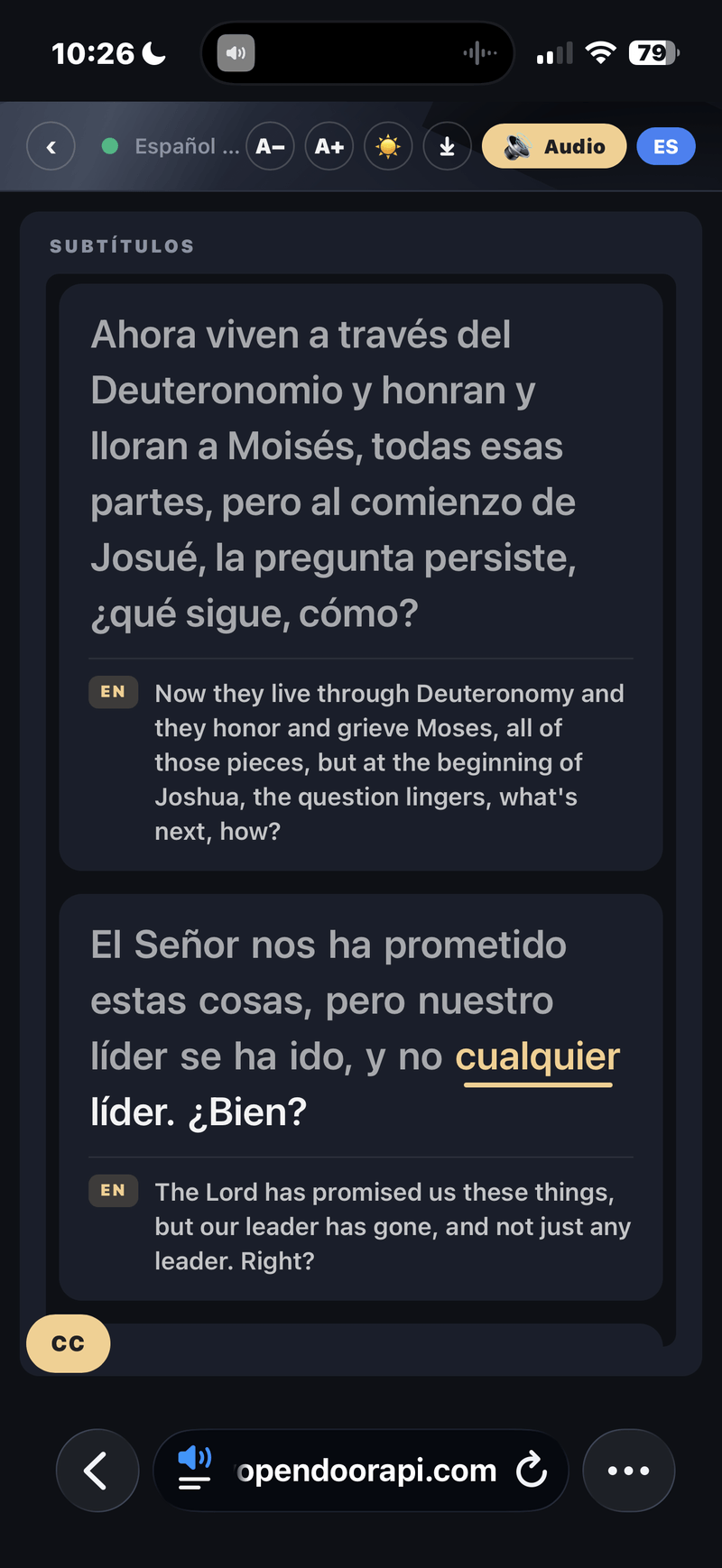
- 4. Printed QR codes. Seat backs, the screen, the bulletin. A guest scans, picks a language, and reads live captions in 190+ languages or listens to a natural voice in 60+ — through their own earbuds. No app, no account.
That’s the whole list. There is no five.
Side by side
| Receiver + headset system | Phone-based system | |
|---|---|---|
| Per-listener hardware | A charged receiver + headset each | The guest’s own phone and earbuds |
| Weekly upkeep | Charge, hand out, collect, clean, store | None — print QR codes once |
| Growing from 10 to 100 listeners | Buy 90 more receivers | Nothing changes |
| Adding a language | Another channel + an interpreter | Guests pick it from the list |
| Who translates | A human interpreter per language, live | The engine — captions and voice |
| Works without internet | ✓ — RF needs no network | ✗ — booth needs a connection; guests need data or Wi-Fi |
| Cost model | Hardware purchase, sized to your biggest crowd | Subscription — published pricing, $0 setup |
| After the service | Collect the receivers | Translated sermon notes publish themselves |
What about dedicated translator earbuds and gadgets?
Consumer translation earbuds and handheld translator devices are built for two people talking, not for one preacher and a room. They translate the conversation their own microphone hears — so in a sanctuary they’re listening to reverb from the back row, not your soundboard. For hallway ministry they can help; for the service itself, the room needs one clean feed from the board, translated once, delivered to every phone. That’s an architecture question, not a gadget question.
The honest decision rule
- No internet in the building, and no way to get it? Traditional RF receivers remain the right call.
- Everything else? The equipment you need is the equipment you have. Spend the receiver budget on nothing — the cost guide shows what a subscription runs instead — and test it on a real Sunday before believing anyone, including us: the trial is a free weekend, no card.
Frequently asked questions
What equipment do I need for church translation?
With a modern phone-based system: an audio feed from your soundboard (or a USB mic, or a wireless lavalier into a phone), one laptop or phone in the booth with a browser, an internet connection for the booth, and printed QR codes for guests. Guests use their own phones and earbuds as the receivers. No transmitters, receiver packs, or headsets to buy.
Do churches still use translation receivers and headsets?
Some do — dedicated RF or FM receiver systems have been the standard for decades, and they still work. The trade-off is per-listener hardware: every guest needs a charged receiver handed out, collected, cleaned, and stored, and adding listeners or languages means buying more units. Phone-based systems moved that hardware to the guest’s pocket.
Is there a translation device for church that doesn’t need Wi-Fi?
Dedicated RF/FM receiver systems run without internet — that is their genuine advantage, and if your building has no usable internet or cell coverage they remain the practical choice. Phone-based systems need internet for the booth and a connection for each guest (their own data plan works; guest Wi-Fi is a fallback). If your Wi-Fi is shaky, wire the booth.
Can guests just use their own phones for church translation?
Yes — that’s the modern model. With MyOpenDoor Translate, a guest scans a QR code, their browser opens the listener page, and they pick a language: live captions in 190+ languages or natural spoken voice in 60+, through their own earbuds. No app, no account, no hardware handout.
Do church translation devices work for a whole congregation?
It depends entirely which kind of device you mean, and the two are opposites. Consumer translator earbuds and handheld translator gadgets are built for two people in a conversation — their own microphone hears the room, not the preacher, so in a sanctuary they pick up reverb and the people nearby. They do not scale past one listener. Dedicated RF or infrared receivers are a different thing: they are built for a room, they work without internet, and they remain the practical choice where connectivity is genuinely unreliable — but each one still needs an interpreter behind it, and you buy, charge, hand out and collect every unit. A phone-based system replaces the receivers, not the interpreter language coverage.
How much does church translation equipment cost?
A receiver-based system is a hardware purchase: per-unit receivers plus transmitters, charging, and storage, sized to your largest crowd — and human interpreters if you translate live. A phone-based service is a subscription instead: MyOpenDoor Translate publishes every tier from $149/month for 6 hours with $0 setup and a 15% nonprofit discount on Starter and Congregation plans. See the full cost guide for the math.
Related reading: how to translate a church service in real time, how much church translation costs, and the best church translation apps in 2026.