
The ugly truth about live interpretation
A pastor spends ten to twenty hours on a message. Nobody has ever measured how much of it reaches the people listening in another language. So we measured it.
Some people can play the guitar. Fewer can play it on a stage, in time, under lights, without a second take. Interpretation is the same kind of gift — holding one language in your ears while producing another with your mouth, in real time, without dropping the thread. It is a genuine talent, and most people who think they have it don’t have it at the level the work actually requires.
Almost anyone can manage hello, goodbye, and have a good weekend. Concepts are a different job. Scripture is a different job. Theology — where a single qualifier decides the meaning of a sentence — is a different job again.
What it costs to be certified
The professional world already knows how hard this is, and it screens accordingly. The federal courts sort interpreters into three categories, and the sorting is the most instructive thing in this article.
| Certified | Passed the Administrative Office’s certification examination |
|---|---|
| Professionally qualified | For languages the certification examination doesn’t cover — requires passing a U.S. State Department or United Nations interpreter test instead |
| Language skilled | Meets neither bar, but can demonstrate to the court’s satisfaction an ability to interpret. Paid at a lower rate than the other two |
Read that third row again. Can demonstrate an ability to interpret is a real classification with a formal name, and the federal courts treat it as the floor — the category you land in when you cannot clear a professional bar.
Clearing that bar is deliberately hard. A candidate first passes a written examination with a minimum score of 75 percent, where the English and target-language sections are scored independently rather than averaged together, so both have to clear the bar. Passing it only earns the right to sit the oral one. The oral examination requires 80 percent, across five sections spanning three modes: simultaneous interpretation, consecutive interpretation, and sight translation in both directions. All three modes are examined — not a candidate’s best one.
Since 1980, across the entire United States, more than 1,400 interpreters have been certified.
Forty-five years. Fourteen hundred people. That is what the professional standard costs, and it is a fair measure of how rare the ability actually is.
What a church does instead
In most churches, interpretation goes to whoever speaks the language best. There is no exam. There is no measurement. There is no review afterward. There is often no recording of what was said, in any language, so there is nothing to review even if someone wanted to.
In the federal courts’ terms, every church interpretation in the country runs at the third tier — and without the demonstration. Not because churches are careless, but because no one ever told them there were tiers.
This is not a complaint about those volunteers. They stepped forward when nobody else would, they serve every week, and they are usually the most willing people in the building. It is a complaint about the fact that nobody has ever checked — and that the person with the most at stake has no way to.
Every other high-stakes field built a credential
Look at where else live interpretation carries consequences, and a pattern shows up immediately. The courts built the certification above. Healthcare built its own national certification, with required training hours and written and oral examinations before anyone carries a message between a doctor and a patient. Diplomacy has the U.S. State Department and United Nations interpreter tests — and the federal courts think highly enough of those to accept them in place of their own examination for languages they don’t certify, which is the middle row of the table above. Conference interpreting has an international professional body a candidate enters by peer review, after logging working days in the booth and being sponsored by long-standing members.
Then there is church. For spoken-language religious interpreting there is no widely recognised certification. Narrow programs exist — a certificate for Catholic religious interpreting, training courses run by ministries — but nothing that functions the way the court, healthcare or conference credentials function. The same point is made plainly in the sign-language interpreting literature: church interpreters tend not to be certified, while their professional counterparts complete training programs, practicum hours and national certification.
Now set the credential beside the material.
A financial interpreter gets the deck and the script in advance. Court testimony is question-and-answer shaped, with bounded vocabulary and a court reporter making a record of it. Diplomats work from prepared statements and briefings. Clinical vocabulary is bounded, and there is a chart afterwards. A pastor goes off script, tells a story, quotes scripture from memory, lands a joke, and shifts register three times in a paragraph — and nothing is recorded, in either language.
The least credentialed field, working on plausibly the hardest live material, with no record afterward. The last of those three is the one that matters most, because it is what makes every other problem in this article invisible.
The measurement nobody makes
Here is the structural problem, and it is the reason this has stayed invisible for decades.
The pastor owns the message and never hears the Spanish. The listener hears the Spanish and has no idea what was in the English. The concern and the visibility sit in two different people, and neither one can close the loop. So the only question that would actually keep a pastor up at night — did my point arrive? — is the one question nobody in the room is measuring.
What does get noticed is everything you can hear without a comparison: the dialect, the pacing, a mislabeled button, the audio lagging by the end. We have watched credentialed interpreters with decades of experience review interpreted services and raise exactly those things — because those are the things that are audible. Completeness is not audible. You cannot hear an idea that was never said.
So we measured it
We took a recorded twenty-minute message and the Spanish interpretation of it, broke the English into 307 distinct ideas, and checked each one against what the Spanish listener actually received.
of the message did not fully arrive — 31 ideas dropped entirely, 17 reversed in meaning, 51 materially weakened, out of 307.
A reversal is the worst of the three. In one case a dropped negation turned we will not succeed in our own effort into its opposite. That is not a translation flaw. That is a different sermon.
And this was the best case
Everything about that test favored the human, deliberately.
| Experience | Ten years interpreting, and familiar with this pastor’s cadence and tendencies |
|---|---|
| Preparation | Days. Multiple listens, with notes |
| Source | A recording — not a live room |
| Length | 20 minutes. A typical sermon runs 35 to 45 |
A live interpreter gets none of that. No advance listen, no notes, no second pass, no pause button — and twice the running time before the message is over. Whatever the number is under those conditions, it is not better than this one.
So 32% is not a worst case. It is a ceiling.
If you told a pastor you were going to leave 30% of his message out, or get it wrong, he would tell you not to interpret at all.
The question that has never been put to him
He would never accept it stated. He has accepted it unstated for years, because nobody measured it and nobody could.
What to measure, in order
- Did the point arrive? Message completeness. The top-line number, and the only one the pastor’s week actually rides on.
- Did any point get reversed? Meaning integrity. Rarer, and worse than an omission — the congregation receives something the pastor never said.
- Does it sound like this congregation? Register and dialect. Real, and worth fixing, but it changes how the message sounds rather than whether it arrived.
- Are the labels and times right? Surface details. Almost all of what listener feedback is made of, and the least important thing on this list.
Most churches collect feedback that lives entirely in rows three and four, and conclude that interpretation is going well.
And our own number
ideas dropped, reversed or weakened, on the same passage, graded the same way.
We are reporting a count, not a rate. Zero errors in a finite sample cannot prove a rate of zero, and we would rather publish what we observed than a percentage that implies more precision than we earned. Twenty minor issues were found in the same pass — awkward phrasing, a couple of anglicisms, some register slips. None of them changed a point.
That test measured translation from a clean transcript. Our live end-to-end number — everything from the microphone to the phone in someone’s hand — is being measured the same way, and we will publish it when it exists and not before.
The point
The point is not that your interpreter is failing you. Your interpreter may be the most gifted person in your building, doing a job that fails most of the professionals who train for it full time.
The point is that nobody has ever known — including you. You have been trusting the most carefully prepared twenty minutes of your week to a process with no measurement, no record, and no way to review it. Everyone else in the industry runs an exam. Churches run on goodwill.
Goodwill is not the problem. Not knowing is.
And your volunteers?
If you have read this far, the next question is probably not about software. It is about two or three specific people who have interpreted from your stage for years, and what any of this means for them. Nothing above is an argument for removing them — it is an argument that nobody, including them, has ever been able to check the work. That conversation is its own guide, written from a church that had it: what happens to your volunteer interpreters when you add AI translation.
What measurement looks like when you have it
The four rulers above are only useful if something in the room can answer them. In most churches nothing can, because nothing is kept. That is the part that changes first, and it changes before any argument about accuracy: the service starts leaving a record.
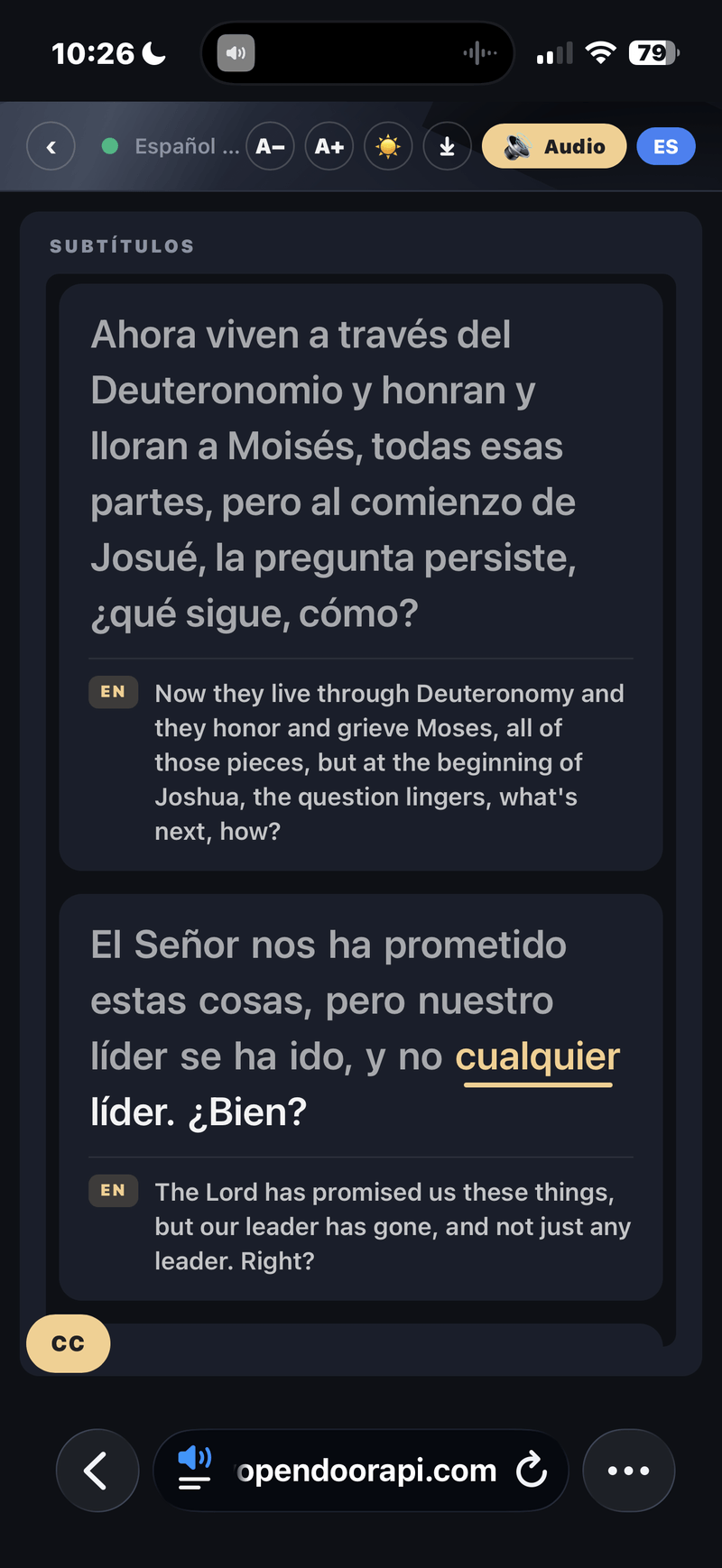
A record, in both languages. Each line arrives with the source line beneath it, and the transcript and the recording are still there after the service. That turns did the point arrive? from a question nobody can answer into one a bilingual member can check on a Tuesday, against the sermon you actually preached.
Every language in the room, not the one you could staff. Volunteer coverage is limited by who you have. Captions run in 190+ languages and spoken voice in 60+, on the phones people already carry, so the second and third language in your congregation stop being a scheduling problem.
No fatigue curve. Minute 42 of a sermon is handled the same way as minute 4. That is not a claim of superiority over a gifted interpreter — it is a claim about the specific failure the measurement above found, which is material quietly shed as a long message wears on.
Checking instead of trusting. Because there is a transcript, a review is a specific line rather than an argument from memory — and the people best placed to do that reviewing are usually the interpreters you already have.
None of that makes our own number perfect. The honest limits above stand, we have not published a live end-to-end figure, and we will not until we have measured one. The narrower claim is the one this whole article has been building toward: the service leaves a record, and a record can be checked.
Frequently asked questions
How accurate is live interpretation at a church service?
Almost nobody knows, because almost nobody measures it. In the one service we measured — a recorded 20-minute message interpreted into Spanish by an interpreter with ten years of experience, working from the recording with days of preparation — we broke the English into 307 distinct ideas and checked each one against what the Spanish listener actually received. 31 ideas were dropped entirely, 17 were reversed in meaning, and 51 were materially weakened: 32% that did not fully arrive. This is one message, so treat it as directional rather than as a population study.
Is that 32% a worst case?
No, it is closer to a ceiling. Every condition of that test favored the interpreter deliberately: ten years of experience, familiarity with the speaker’s cadence, days of preparation with multiple listens and notes, a recording rather than a live room, and a 20-minute message when a typical sermon runs 35 to 45 minutes. A live interpreter gets none of that and has roughly twice the running time to sustain.
How hard is it to become a certified interpreter?
Hard enough that the federal courts have certified more than 1,400 interpreters in the entire United States since 1980. A candidate first passes a written examination with a minimum score of 75 percent, and the English and target-language sections are scored independently rather than averaged, so both must clear the bar. Passing it only earns the right to sit the oral examination, which requires 80 percent across five sections spanning three modes: simultaneous interpretation, consecutive interpretation, and sight translation in both directions. These figures are published by the Administrative Office of the U.S. Courts. The courts do not publish pass rates, and we make no claim about them.
What should a church actually measure about its interpretation?
Four things, in this order of severity. First, did the point arrive — message completeness, the only number the pastor’s week really rides on. Second, did any point get reversed — a congregation receiving something the speaker never said is worse than an omission. Third, does it sound like this congregation — register and dialect, real and worth fixing, but it changes how a message sounds rather than whether it arrived. Fourth, are the labels and times right — surface details, which is what almost all listener feedback is made of and the least important thing on the list.
What is your own measured accuracy?
On the same passage, graded the same way, 0 of 307 ideas were dropped, reversed or weakened. We report that as a count rather than a percentage on purpose: zero errors in a finite sample cannot establish a rate, and we would rather publish what we observed than a figure implying more precision than we earned. Twenty minor issues were found in the same pass — awkward phrasing, a couple of anglicisms, some register slips — and none of them changed a point. That test measured translation from a clean transcript. Our live end-to-end number, everything from the microphone to the phone in someone’s hand, is being measured the same way and we will publish it when it exists and not before.
Sources and method
Sources. The interpreter categories, the examination structure, the passing scores, and the number of interpreters certified since 1980 are published by the Administrative Office of the U.S. Courts: interpreter categories and the Federal Court Interpreter Certification Examination. Verified 10 August 2026. The courts do not publish pass rates for the certification examination, and this article makes no claim about them — widely repeated figures exist, but none we could trace to an official source, so none appear here. Healthcare interpreter certification requirements — training hours plus written and oral examinations — are published by the Certification Commission for Healthcare Interpreters; conference interpreting admission by peer review and sponsorship is published by the International Association of Conference Interpreters.
On the absence of a religious-interpreting credential. That is a negative claim, and negative claims are the hardest to stand behind, so here is exactly how far ours goes: we could find no widely recognised certification for spoken-language religious interpreting, only narrow programs — a certificate in Catholic religious interpreting, and training courses run by ministries. The clearest published statement of the pattern is in the sign-language interpreting literature, which says church interpreters tend not to be certified while their professional counterparts complete training programs, practicum hours and national certification. If a recognised spoken-language credential exists and we have missed it, tell us and we will correct this page.
Method. The English source was segmented into 307 idea units. Each was checked against the interpreter’s actual recorded words and scored as arrived, weakened, reversed, or dropped. The same passage and the same scoring were then applied to our own translation. Full method and data available on request.
Related reading: how to translate a church service live, offering Spanish translation at your church, helping your listeners get the best experience, and what it costs.