
What happens to your volunteer interpreters when you add AI translation
If you are reading this, the question in your chest probably is not about languages or price. It is about two or three specific people. They have interpreted from your stage for years. They have never missed a Sunday. And you are looking at a system that does what they do, in more languages, and you feel like you are about to hurt them. That worry is the right instinct, and the fact that you are asking the question first says something good about how you pastor. Here is the honest answer, from a church that went through it.
The honest part first: it did not go over well
Our founder is a pastor. He made this change at his own church before he ever built a product out of it, and he does not pretend it was smooth:
“It was not met with the greatest enthusiasm, because their identity was in it and in the way they serve their church… Initially, I felt like I was firing them.”
That is worth sitting with rather than skipping past. Interpreting is not a task those volunteers picked up; it is how they belong here. In his words, it is like the person at the front door welcoming people, the person in the kitchen, the one making breakfast, the one serving coffee. These people have been faithful for years. Anything that touches that touches more than a schedule.
So if the conversation at your church lands awkwardly, that is not a sign you made the wrong call. It is a sign the role mattered. Any article that tells you this transition is easy is written by someone who has not had the conversation.
The translating was never the point — the people were
Ask what interpretation in church is actually for, and the answer is never “so the equipment gets used.” It is so a family can understand the sermon, and so they know this room is for them too. The equipment was only ever the means.
Here is what that looked like in his lobby before the change: a couple of transmitters on a table and a small sign that said, in effect, if you need translation in Spanish, here’s a headset. That is a real service, offered honestly. But as he puts it, it wasn’t obvious to people that translation was important to us. A sign is not a welcome. A table is not a person.
Meanwhile the volunteers were tucked away in a back room, speaking into a microphone, out of sight. They loved the work — and almost never met the people they were serving.
What the change actually was: a lobby, not a layoff
The plan at his church was not “we bought software, thank you for your service.” It was a renovation:
- They redid the lobby and built a translation section into it — a real, visible station that greets people as they walk in the door, positioned so that anyone entering can see that translation matters here.
- The interpreters were moved into it. Not to run gear — to be present, to speak the language out loud in the lobby, to have actual conversations with guests in their own language, and to encourage that language to be spoken in the room.
- Guests joined the translation on their own phones by scanning a QR code — no app, no account, no headset to hand out and collect. Which is precisely what freed the volunteers from the table.
Look at the before and after. Before: two transmitters and a small sign. After: people in the room who greet you in your language, know your face, and walk you into the church. That is a promotion. Say so plainly — and then be honest that it may not feel like one at first. In his words, the adjustment was difficult for them. What carried it was staying in touch with them, helping them through it, and making sure they could see that this was never about their translations not being good enough.
How to have the conversation
This part is your job, not the software’s. No vendor, ours included, can do it for you.
1. Decide their new role before you say a word
The single most common mistake is announcing the technology and promising to “figure out the rest.” To a volunteer, that is a layoff with a delay on it. Walk in with the post already named: here is where you’ll stand, here is who you’ll meet, here is why I need you there.
2. Say it in person, and say it first
They should not learn this from a slide, a group text, or a rumor after a staff meeting. Tell them before the church knows.
3. Name the tension out loud
Do not sell it as an upgrade for them. Say the true version: this is a change, it may feel like something is being taken, and you are not going anywhere while they get used to it. Making room for the feeling is what keeps it from turning into a quiet exit six weeks later.
4. Make it clear this is not a verdict on their work
This is the fear underneath, and it usually goes unsaid. Address it directly: the change is about reaching more languages and more people, not about their translations being deficient.
5. Show them before you launch
Our founder invited two women who had translated from his stage for years over to see it before it was ever used in a service. It was a rough night, technically — his words: “We had all kinds of little bug issues that night.” It did not matter. What they responded to was not the product:
“What they appreciated most was the effort. They knew I thought of them and cared about them… just seeing them say, ‘Wow, that’s amazing. That is so cool. And thank you, Charles, for thinking of us. Thank you for helping in this way.’ That was the most incredible moment that I will always remember.”
You can do that in a living room, a fellowship hall, or twenty minutes after a Wednesday rehearsal. It is the cheapest and highest-return step in this entire process.
The roles that genuinely open up
These are not invented jobs to soften a blow. Each one is real work that your church needs and that nobody is currently doing well:
- Lobby host in their language. The core move. Standing where people arrive, greeting them in the language they think in, and getting them to the seat. Belonging starts here, not in the sermon.
- Welcome and follow-up. Second-language guests are the ones most likely to visit once and disappear, because nobody knew what to do with them on Monday. A volunteer who speaks the language is the right person to make that call.
- Glossary keeper. Every church has proper nouns the world does not know: your pastors’ names, your ministry names, your neighborhood, the way you say things. Those go into a per-account glossary so they come through right, and names get more accurate over time as the system learns them. Someone has to know which words matter. A long-serving interpreter is exactly that person.
- Quality ears. Once a month, have them listen to a service in their own language and tell you honestly what landed and what did not. Recordings and transcripts are downloadable after every service, so they can check a specific line rather than argue from memory. That is a job you cannot hire off the street.
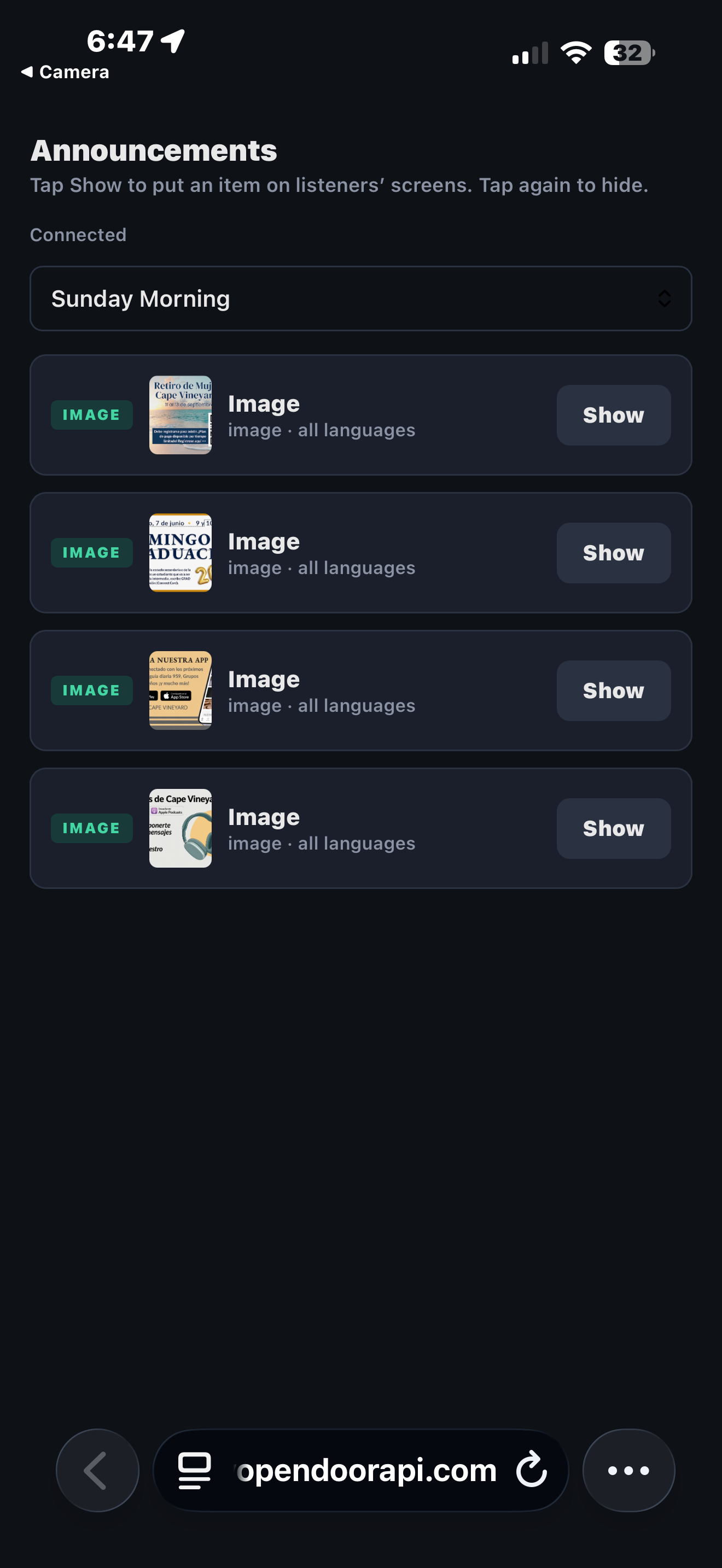
- Announcements and response moments. Announcements can be run from a volunteer’s own phone during the service — text, images, and branded cards pushed to guests in their language — and a decision or response card at the end takes one tap in the guest’s own language. A person who understands the congregation should be choosing when those go out.
- Sermon-notes follow-through. After the service, guests get study notes and the full transcript in their language. Someone who knows those families is the right person to put that in their hands and ask what they thought.
Where a human interpreter is still the right answer
We would rather say this than oversell. Live translation is built for one voice going out to a room — a sermon, a talk, an announcement. That is what a service is, and it is what the system does well: captions in 190+ languages and natural spoken voice in 60+, delivered to each guest’s own phone, faithful to what the speaker actually said rather than a paraphrase of it.
But a great deal of church happens in conversation, and conversation goes both ways. Prayer ministry. Counseling. A hospital room. A small group where six people talk over each other. A hard conversation with a parent in the hallway. In those rooms, a person who speaks both languages is not a fallback — they are the right answer, permanently. If you have volunteers with that gift, you have not lost a resource. You have finally freed it from the equipment table.
You do not have to do all of it at once
If your church has never done any of this, none of the above is the first step. This one is:
“I honestly think the first good step in a multi-language church is just teaching your greeters how to say hola, ¿cómo estás? … that would make them smile, is to see that effort.”
And the sentence a founder who sells translation software is not supposed to say:
“My best invention here, or product, wasn’t the translation or all the features that come with it. It was learning how to say hello and goodbye and connecting them to our translation booth, where really the first steps of belonging happen.”
It is a journey. Greeting first, then a visible place in the lobby where people are met in their language, then the technology carrying the words further than your volunteer team could ever staff. Churches that do it in that order tend to keep their volunteers — because at no point did the volunteers stop being the point.
Frequently asked questions
Will AI translation replace our volunteer interpreters?
It replaces the equipment job, not the people. Somebody standing at a transmitter speaking into a headset channel is doing a technical task; the reason that task existed was so a family could understand and belong. The software can carry the words to every phone in the room, in more languages than a volunteer team can staff. What it cannot do is know someone by name. That is the job worth moving your interpreters into.
How do I tell a volunteer who has interpreted for years?
In person, before anyone else hears it, and with their new role already decided. Do not open with the technology — open with what you have noticed about them and what you want them to do next. Say plainly that this is a change and that it may feel strange. Then ask them to help you build the new thing rather than announcing it to them. Our founder invited two women who had translated from his stage for years to see the product before it was ever used in a service; what they responded to was not the software, it was being thought of.
What do interpreters charge per hour?
Professional interpreters set their own rates and they vary widely by language, region, certification, and whether the booking is simultaneous or consecutive — ask for a quote locally rather than trusting a number off the internet. Most churches never see that figure, because their interpreters are volunteers giving Sundays away for free. That is exactly why this decision is pastoral rather than financial: you are not cutting a line item, you are changing what faithful people do.
Is there still a job for a human interpreter at our church?
Yes, in specific places. Anywhere the conversation goes both directions — pastoral care, prayer ministry, counseling, hospital visits, small groups, a parent conversation in the hallway — a human being is the right answer and always will be. Live translation is built for one voice going out to a room, which is what a service is. Those are different problems and it is fine to solve them differently.
What can a former interpreter actually do instead?
Host the lobby in their language and greet guests by name; run the welcome and follow-up for second-language families; maintain the glossary of proper nouns, ministry names, and terms your church uses so they come through right; listen to a service in their language now and then and tell you honestly what sounded off; and run announcements from their own phone during the service. Every one of those is closer to ministry than standing at a transmitter was.
What is the smallest first step toward being a multilingual church?
Teach your greeters one sentence of greeting in the language of the families you already have. It costs nothing, it is not a project, and it does more than most churches expect. Our founder says his best product was never the translation — it was learning how to say hello and goodbye, and connecting people to a place where belonging starts.
Related reading: the ugly truth about live interpretation — what we measured about how much of a message actually arrives, how to translate a church service live, helping your listeners get the best experience, live translation for churches, and what it costs.